




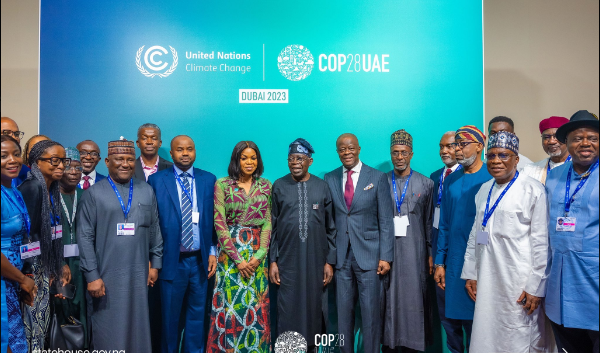
Nigeria’s GDP ranks lower than these 12 countries with fewer COP28 delegates.
This is according to data from Statisense, revealing that Nigeria’s economy ranks lower compared to many countries that sent fewer delegates to COP28.
This data sheds light on Nigeria’s economic challenges, indicating a spending issue. The findings from Statisense provide insights into the economic positions of several countries:
Nigeria sent 1,411 delegates to COP28 while maintaining a $477.37 billion gross domestic product (GDP). Indonesia follows closely with 1,229 delegates, marking a substantial $1.32 trillion in economic size.
Japan took 1,067 delegates boasting a significant $4.24 trillion in economic strength. Turkey has 1,045 delegates, representing an economic volume of $905.84 billion.
India follows with 948 delegates, showcasing an impressive economic worth of $3.39 trillion. France with 800 delegates has a robust $2.78 trillion in economic value.
The USA has 770 delegates with an immense economic scale of $25.46 trillion. Canada with 742, has a $2.14 trillion economy.
Israel has 718 delegates but possesses a considerable economic volume of $525 billion.
The UK with 697 delegates, exhibits a substantial economic scale of $3.08 trillion.
South Korea follows closely with 689 delegates, and showcases an economic value of $1.67 trillion.
Russia secured 590 delegates, showcasing a significant economic worth of $2.24 trillion.
Meanwhile, Italy has 533 delegates boasting an economic scale of $2.01 trillion.
Balancing both sides
The federal government of Nigeria will pay the expenses for 90% of the 1,411 delegates at the conference of parties (COP28). This is according to a source familiar with the matter.
In a conversation with Nairametrics over the weekend, the source revealed that the Nigerian delegates consist of both party and party overflow attendees.